
Week one01
Custom fields for everything
Carrier, product, face amount, draft date, beneficiary, writing number. Each one is a text field someone has to keep consistent.
Pipelines built for software and real estate stop at closed-won. Life insurance starts paying, and charging back, after that, across a hierarchy the CRM has never heard of.
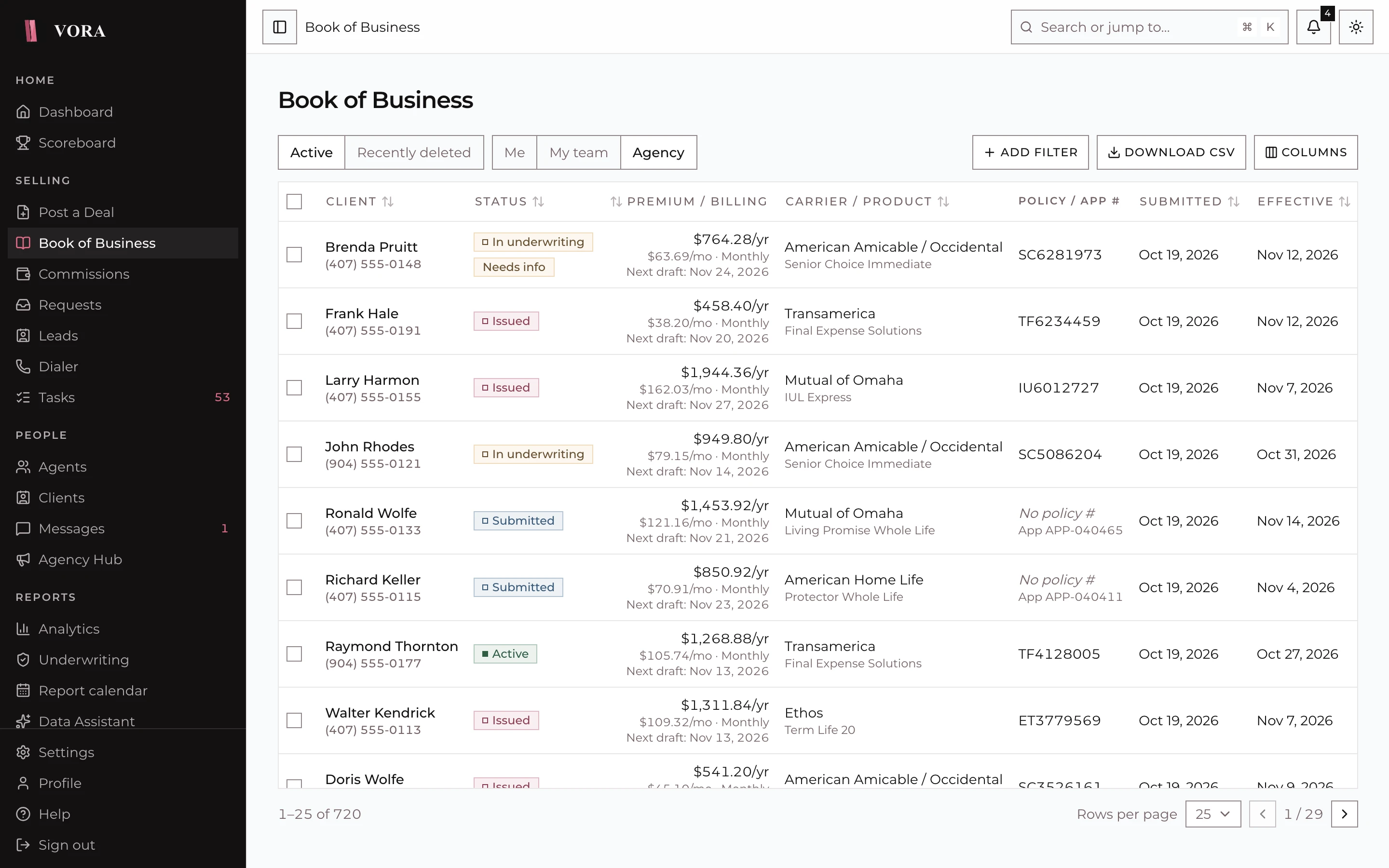
Drag the handle. Left: an example of generic CRMs. Right: a real Vora screen with example data.
Every gap is fillable with custom fields, add-ons and a consultant. That is the problem.
Carrier, product, face amount, draft date, beneficiary, writing number. Each one is a text field someone has to keep consistent.
The deal card says won. It does not know about underwriting, issue, the first draft or a lapse in month four.
Commissions live in another tool, or a sheet, because the CRM has no grid, no positions and no advances.
Calling windows, DNC, consent and abandon rates sit in a separate dialer, and proving what happened means stitching two exports together.
Topic by topic, what it typically looks like today and what changes on Vora.
A generic CRM stores whatever the carrier report says. Vora translates it into one status everyone understands.
What the carrier report says
Vora shows In underwriting
Example carrier wording. Vora keeps a status map per carrier and flags new wording for review.
We do the moving. Your agency keeps selling while it happens.
CSV or XLSX. We map the custom fields to real policy fields.
Carriers, products, the commission grid, positions and uplines.
Leads import with phone validation, time zones, DNC scrub and consent checks.
Tell us what you have customised so far. We will show you where each field lives in Vora, already built.